The IUCN Red List remains the most widely used global benchmark for understanding extinction risk and guiding conservation action. Yet tropical insects, despite representing the majority of biodiversity in regions like Borneo, remain largely absent from these assessments. This gap reflects persistent challenges, including limited data on species distributions and trends, difficulties in applying Red List criteria to invertebrates, and limited coordination between tropical entomologists and formal assessment processes.

New Publication: Towards red listing understudied tropical insects: A case study of the dung beetles of Sabah, Malaysian Borneo
A recent study published in Insect Conservation and Diversity by researchers from Nanyang Technological University (NTU Singapore) addresses this gap directly. Led by the Tee Lab and working with collaborators in Sabah and the wider research community, the team developed a practical framework for applying the IUCN Red List approach to data-limited tropical insects. Using this method, they conducted both regional and global assessments of 159 dung beetle species from Sabah, demonstrating how these often-overlooked taxa can be systematically evaluated and incorporated into mainstream conservation planning.
Research Focus and Findings
The study uses dung beetles as a case study to show how conservation status can be inferred from species distributions, habitat associations and ecological traits, even where data are limited. Because dung beetles respond rapidly to environmental change, they are reliable bioindicators so shifts in their diversity and community structure closely track changes in forest quality, fragmentation and land use.
The results of this study indicate that intact and well-connected forests support the richest and most functionally diverse communities; logged or lightly modified forests can retain significant biodiversity value where ecological structure is maintained; and heavily converted landscapes support simplified communities with reduced ecosystem function. Together, these findings emphasise the importance of landscape-scale management, rather than focusing only on isolated protected areas.
Relevance to Sabah’s Landscape
This work is directly relevant to Sabah, where forests and biodiversity underpin water security, climate resilience and key economic sectors including tourism and agriculture. There is growing recognition locally that natural capital is central to Sabah’s long-term development pathway, and this dung beetle research provides a practical evidence base for this view. It shows how ecological condition can be monitored cost-effectively, and how biodiversity responses can guide decisions on restoration, land use and conservation prioritisation.
CONTRIBUTION TO CONSERVATION PRACTICES
Beyond its immediate findings, the study makes three key contributions to applied conservation. It establishes a replicable method for assessing poorly known insect species within global frameworks such as the IUCN Red List, helping close a major data gap. It increases the visibility of understudied insect groups, ensuring conservation planning reflects the full breadth of tropical biodiversity rather than focusing primarily on vertebrates. And by demonstrating the value of dung beetles as indicators, it provides a practical decision-support tool for evaluating the ecological outcomes of forestry, restoration and agricultural management. Expanding conservation assessments to include insects is essential for understanding ecosystem health and resilience in tropical landscapes. The NTU-led research shows that integrating these taxa into mainstream conservation frameworks is both feasible and necessary.
For Sabah, where development and conservation must be managed within the same landscape, this type of evidence supports better policy, more effective restoration, and a clearer understanding of how biodiversity underpins long-term stability and prosperity. Ultimately, the study demonstrates that robust conservation science can be built even for understudied groups — and that these insights can directly inform how tropical landscapes are managed in practice.
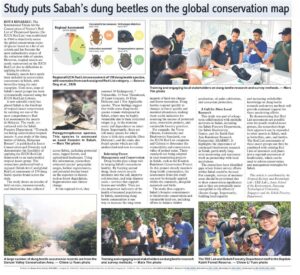

You can read the NTU TEE Lab write up about this publication here.

There is also a YouTube video explainer that speaks to this research from the TEE lab here.
